

Management ConsultancyService
Logistics contract KPIs and the perfect order rate
The KPIs worth putting in a logistics contract, defined tightly enough for both sides to sign.
Kaelo Global is a Dubai company licensed in Meydan Free Zone, with over 100 clients served so far.
At a glance
What it is
A logistics contract should carry a short list of KPIs the provider controls, each defined by its measurement point, exclusions, data source and time window. Perfect order rate heads that list. Name ASCM's SCOR definition, which counts the orders perfect on all 4 components, because every failed order can then be identified and checked. APQC's method multiplies 4 rates and belongs on the scorecard, for comparison with APQC's benchmark.
OTIF needs the same care. McKinsey and the Trading Partner Alliance found in 2019 that OTIF has no standard definition, so a shipper and its provider can read the same metric in very different ways.
We write KPI schedules for 3PL and transport contracts in the UAE and measure a baseline before any target is agreed. Your lawyers decide how the schedule sits in the agreement.
Which KPIs belong in the contract
The contract carries the measures the provider controls and both sides can evidence from the same records. Everything else goes on the quarterly scorecard, with no remedy attached. If the provider can miss a target because of something you or your customer did, the measure needs an exclusion that covers it, or it moves to the scorecard.
Scope decides the list. A warehouse-only provider is held to on-time shipment and picking accuracy at the dock, since delivery depends on a carrier you appointed. When the provider also delivers, we start from 4 contract KPIs:
- Perfect order rate, counted the SCOR way, with its 4 components underneath.
- Dock-to-stock time, from arrival until the stock can be allocated.
- Internal order cycle time, from release to the provider until dispatch.
- Inventory record accuracy, from cycle counts you can attend.
The scorecard carries OTIF against your customer's requested date, perfect order calculated APQC's way, SCOR's order cycle time to customer acceptance, and monthly volumes to read service against workload.
The Warehousing Education and Research Council (WERC) tracks 36 metrics in its 2026 DC Measures report. A remedy on each would turn every monthly review into a negotiation. Settle the contract list during 3PL selection, while bidders still compete on it.
Perfect order rate, component by component
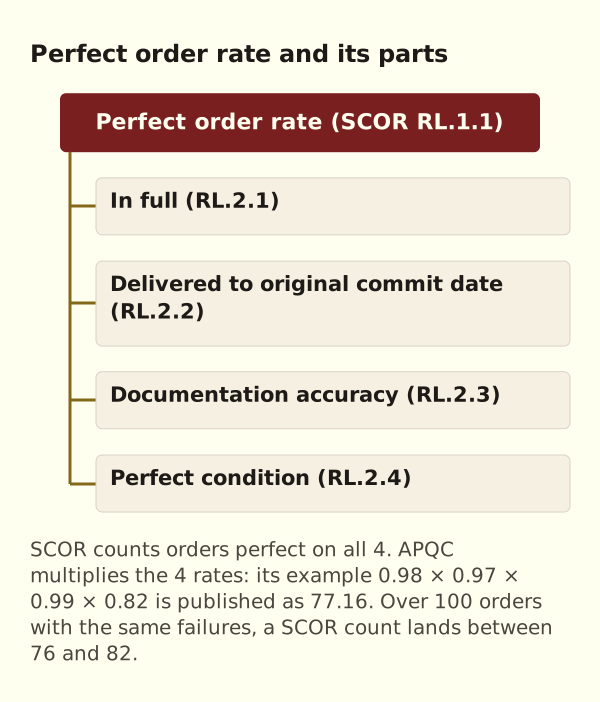
ASCM's SCOR standard calls the measure Perfect Customer Order Fulfillment (RL.1.1): the percentage of orders meeting delivery performance expectations, including complete and accurate documentation and no delivery damage. It has 4 components:
- In full (RL.2.1).
- Delivered to the original commit date (RL.2.2).
- Documentation accuracy (RL.2.3).
- Perfect condition (RL.2.4).
An order line is perfect only when all 4 are perfect, and the rate is perfect orders divided by total orders, times 100. Because RL.2.2 uses the original commit date, moving the date later does not rescue a late order.
APQC multiplies the 4 rates instead: on time × complete × damage-free × accurate documentation × 100. Its own example multiplies 0.98 × 0.97 × 0.99 × 0.82 and publishes 77.16, the product cut to 2 decimal places. Apply those rates to 100 orders, with 2 late, 3 incomplete, 1 damaged and 18 with document errors. If every failure falls on a different order, 76 are perfect. If the 6 other failures all sit among the 18, 82 are perfect. The 2 methods agree only when failures fall on orders independently of each other.
Name SCOR's count in the contract. Every imperfect order then has an order number and a record of the failed component, so a disputed month is settled order by order. A product of 4 rates cannot be traced to any order. Keep APQC's method on the scorecard for benchmarking. Its cross-industry median is 88.0% from a sample of 13590 (APQC measure page, October 2026), and your figure compares with it only when calculated the same way.
SCOR states its rule for the order line and its formula in orders, so the contract must choose. We write the headline at order level, since your customer receives the order as a single delivery, and report lines underneath.
OTIF has no standard definition, so the contract writes one
McKinsey and the Trading Partner Alliance (TPA), a GMA and FMI industry group, defined OTIF in June 2019 as delivery to destination according to both the quantity and the schedule on the order. In SCOR, RL.2.2 has no in-full element, so a partial delivery can still be on time, and RL.2.1 has no timing element.
An OTIF definition in a contract has to settle 4 points:
- The reference date, requested or promised. In the TPA survey of 24 North American consumer-goods retailers and manufacturers, 67% preferred the requested date.
- The window, a delivery slot or something wider. The survey found no consensus on its width.
- The level for in full: order, line, case or individual unit. Of the 24 firms, 79% preferred case level.
- Early delivery. The paper's proposed standard allows 1 day early and measures to the end of the working day.
The level moves the score. An order of 100 cases with 1 line short by 5 cases is 95% in full by case and a failure by order.
For a 3PL contract we set the commit date by formula: release time plus the agreed lead time for the delivery zone, with orders after the daily cut-off counting from the next working day. Nobody can then move the date to protect a score. The requested date stays on the scorecard, since your customer holds you to it. Count in full at the level your own customers count you on, so the contract mirrors your exposure. Where consignees book delivery slots, measure against the slot with a stated tolerance either side. Elsewhere use the TPA whole-day rule with its 1 day early allowance, since it is easier to evidence.
Where the clocks start and stop
Order cycle time changes meaning between standards. SCOR's Order Fulfillment Cycle Time (RS.1.1) runs from order receipt to customer acceptance, in days. WERC counts in hours. Its 2025 best-in-class marks were under 3.36 hours for internal order cycle time and under 6 hours for total order cycle time, according to the 2025 summary of WERC data by Yale, the materials handling firm that sponsors the report. For a 3PL the useful clock runs from the WMS release timestamp to dispatch confirmation, with the commit date's cut-off rule.
WERC defines dock-to-stock as the time elapsed between the arrival of goods and when they are put away and recorded into inventory management systems. In WERC's 2026 DC Measures, as summarised by its sponsor Yale, best in class (the top 20% of respondents) was under 3.1 hours, down from under 3.5 hours in 2025.
Arrival is the contested end. We define it as gate-in or the booked appointment, whichever is later, so an early truck costs the provider nothing, and we stop the clock when the stock can be allocated. The exclusions form a closed list:
- Loads that arrive without an advance shipping notice.
- Stock you place on quality hold.
- Discrepancies awaiting your instruction.
- Floor-loaded containers, which need their own standard because loose cartons take longer to unload than pallets.
Elapsed hours penalise a load that arrives an hour before the shift ends, hence we count working hours and attach the site's shift and holiday calendar.
A definition page for every contract KPI
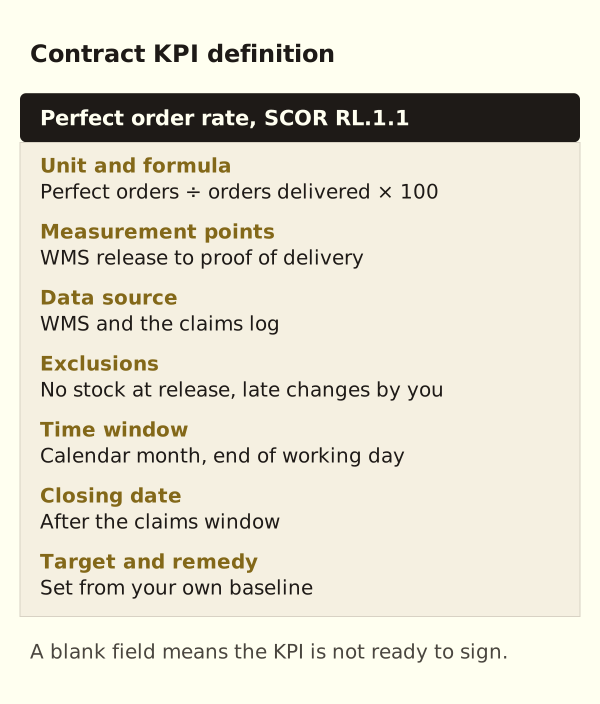
Logistics KPI definitions hold when each contract KPI gets a page with the same 8 fields. A blank field means the KPI is not ready to sign.
- Name and reference: the standard followed, such as SCOR RL.1.1, and any change to it.
- Unit and formula: what is counted, with numerator and denominator written out.
- Measurement points: the events that start and stop the clock.
- Data source: the system of record for each timestamp, and which wins when 2 systems disagree.
- Exclusions: a closed list, each with the evidence needed to claim it.
- Time window: the reporting period and on-time tolerance, with the site calendar attached.
- Closing date: when the month's result becomes final.
- Target and remedy: the target from the baseline, and the remedy as your lawyers place it.
The closing date matters most for perfect order, since documentation errors and damage can surface through claims after delivery. We close each month after a fixed claims window. Your customer reports those errors to you, hence the provider needs read access to the claims log. The contract should also give you the order-level extract behind each monthly report, so any figure can be recomputed.
The same pages can go into a tender, so bidders price the service they will be measured on and your tender scoring matrix can weight it.
Targets come from your own baseline
None of the published benchmarks is a target. WERC's public figures are best-in-class marks for the top 20% of respondents, such as on-time shipments at or above 99.5% and order-picking accuracy at or above 99.7% in 2026, according to the sponsor's summary. The medians sit in the full report, which costs US$550 for non-members (MHI, May 2026). We set targets from a baseline measured under the definitions you intend to sign, over a period that includes your peak, because a target copied from someone else's top quintile invites a dispute from the first month.
The same discipline applies to carriers you contract directly, which our freight procurement work covers. If you run a 3PL, publishing how you calculate perfect order gives buyers something to test. Our 3PL marketing work, part of our wider logistics marketing practice, helps providers put that evidence in front of buyers.
What's included
Four areas of scopeKPI schedules written to be signed
We write a definition page for each contract KPI, from reference standard to closing date, for your operations team and the provider to review field by field.
Perfect order with its components visible
We count perfect order rate the SCOR way and report in full, commit-date delivery, documentation and condition underneath. A falling score then points at its cause.
A baseline before any target
We measure the current operation against the draft definitions first, so both sides can defend the target at the first monthly review.
Reconciling the provider's report with yours
When the figures disagree, we trace the gap to its cause, whether a different reference date, a different unit, a missing exclusion or a timestamp from the wrong system.
How the work runs
Inventory of measures
What is measured today, and from which system.
Definition workshop
Each contract KPI taken through the template with your team, and the provider where the contract is live.
Baseline
The operation measured against the draft definitions before targets are agreed.
First closes
We run the first monthly closes with your team and correct any definition that causes a dispute.
When to come to us
- 01You are writing or renewing a 3PL or transport contract and the KPI schedule is a list of headings.
- 02Your provider reports green while your customers complain about short or late deliveries.
- 03Service credits turn into a negotiation at each monthly review.
- 04You want to benchmark and need to know which formula sits behind a published figure.
What we do not do
- Drafting the contract's legal terms or advising on whether a remedy is enforceable.
- Setting targets from best-in-class figures before your own baseline exists.
- Attaching remedies to measures the provider does not control.
- Publishing a universal target for perfect order rate.
Related reading
The questions that reveal how a logistics provider really works.
What belongs in the scoring matrix, and how to agree the weights.
Tender design, carrier selection and cost baselining, explained as a practical method.
Our specialist practice for freight forwarders, customs brokers, carriers, 3PLs and removals companies in the UAE.
Common questions
How many KPIs should a 3PL contract carry?
What is a good perfect order rate?
Is OTIF the same as perfect order rate?
Is this legal advice?
Sources
- ASCM, SCOR Digital Standard, RL.1.1 Perfect Customer Order Fulfillment, accessed 2026
- ASCM, SCOR Digital Standard, RL.2.1, accessed 2026
- ASCM, SCOR Digital Standard, RL.2.2, accessed 2026
- ASCM, SCOR Digital Standard, RS.1.1 Order Fulfillment Cycle Time, accessed 2026
- APQC, Open Standards Benchmarking, Perfect order performance (measure 101741), 2026
- McKinsey & Company with the Trading Partner Alliance, Defining on-time, in-full in the consumer sector, 2019
- Yale (Hyster-Yale), summary of WERC's 2026 DC Measures report, 2026
- Yale, infographic summarising WERC DC metrics, 2025
- MHI Blog, on WERC's 2026 DC Measures report, 2026
Last reviewed 17 October 2026. How we research, write and correct these pages is set out in our editorial standards.