

Digital MarketingService
Multi-brand marketing strategy for UAE groups
For groups deciding which marketing the centre runs and which each brand keeps.
Kaelo Global is a Dubai company licensed in Meydan Free Zone, with over 100 clients served so far.
At a glance
What it is
A multi-brand marketing strategy settles 2 questions for a group: how closely each brand is tied to the group name, and which marketing decisions sit with the centre and which with each brand. The first is brand architecture. For the second, our answer is to run the shared layer from the centre: trademarks, customer data and consent, the martech stack and the media contracts. Each brand keeps its positioning and writes its own plan, because it carries its own profit.
In the UAE the customer data side has a legal edge. In our reading, the Personal Data Protection Law has no exemption for group companies, and sharing data between them counts as processing.
Brand architecture: where each brand sits
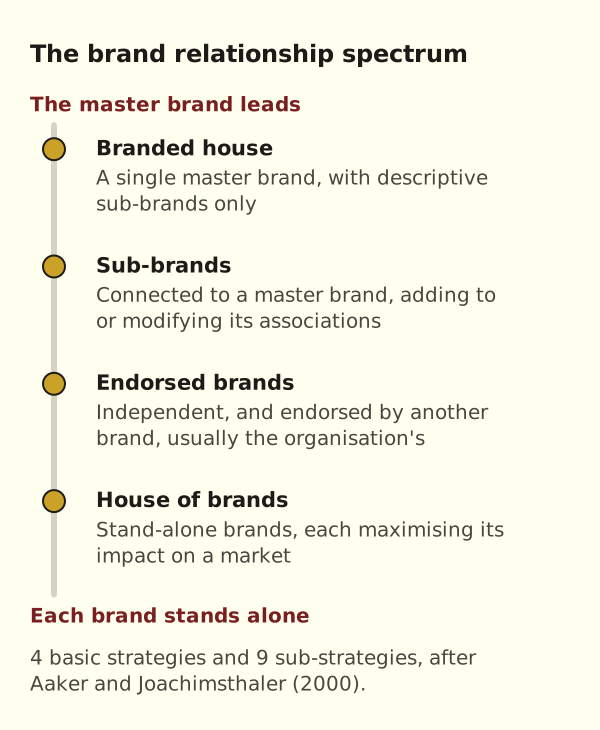
David Aaker and Erich Joachimsthaler describe brand architecture as the structure of a brand portfolio "that specifies brand roles and the nature of relationships between brands". Their brand relationship spectrum, published in California Management Review in Summer 2000, sets out 4 basic strategies and 9 sub-strategies. From the master brand outwards:
- Branded house: "a single master brand" spans the offerings, with "only descriptive subbrands".
- Sub-brands: "connected to a master or parent brand", adding to or modifying its associations.
- Endorsed brands: "still independent", but "endorsed by another brand", usually a corporate brand.
- House of brands: "an independent set of stand-alone brands". The authors' example in 2000 was Procter & Gamble, with "over 80 major brands, largely with little link to P&G or to each other".
Moves along the spectrum happen in public. Etisalat Group changed its brand identity to e& from 23 February 2022, and in June 2022 unveiled "etisalat by e&" for Etisalat UAE, an endorsed brand under the group's master brand. By October 2026 the group's homepage was published as Etisalat Group and said the business would carry on "under the name we started with".
A group can sit at several points at once, so we place every brand with the reason written down. Whether a brand carries the group name has its own tests, set out in deciding which brands carry the parent's name. The identity that follows is our brand strategy and identity work.
Group marketing governance: the centre and the brands
At P&G, the units that write the marketing plans also carry the profit in its largest markets. Its 10-K for the year to 30 June 2026 says its global category units, which it calls SBUs, "are responsible for global brand strategy, product upgrades and innovation, marketing plans and supply chain". Its account of its structure gives them "sales, profit, cash and value creation responsibility" for its largest markets.
LVMH starts from the brands. Its 2025 Universal Registration Document names brand autonomy and decentralisation among the group's fundamental principles, and says: "While respecting the identity and autonomous management of these brands, LVMH supports their growth by providing them with shared resources." It reports advertising and promotion for the whole group at 11.4% of revenue in 2025. A group can watch that total without writing each brand's plan.
Some decisions only the centre can take. In 2019 Majid Al Futtaim announced that SHARE would replace the loyalty programmes across its ecosystem, with customers keeping the value they had already earned.
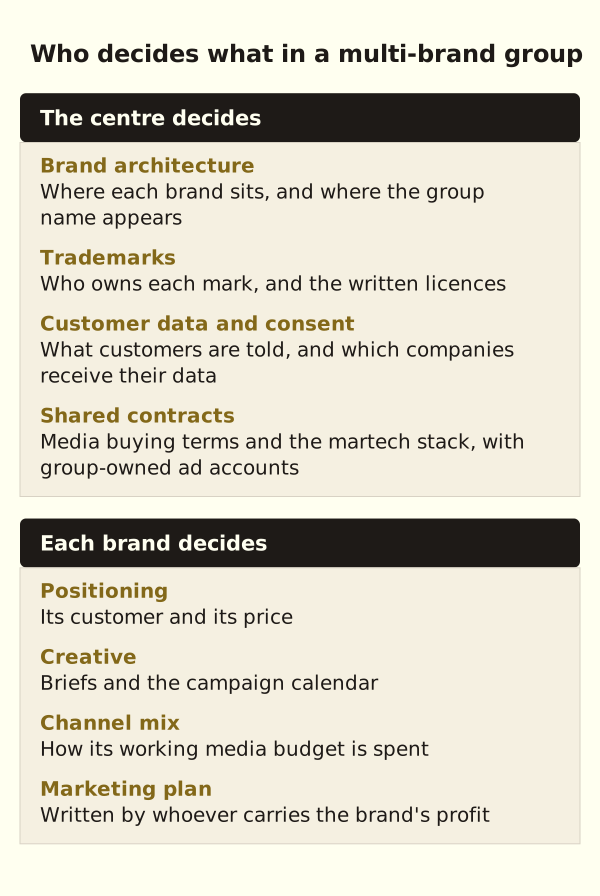
Our starting split follows that logic. The centre takes the decisions where the brands share a risk or a cost, such as architecture, trademarks, the consent model and the media and martech contracts. Each brand takes those that touch its own customer, starting with positioning and the plan. The budget, reporting definitions, cross-brand offers and any group loyalty programme are agreed each year. The centre charges the shared layer back by a written rule, and each brand owns its working media. Honest charging can change which brands look worth keeping, as our note on consumer brand portfolios explains.
We face the same questions across our own 4 activities, including our label, wearon.co. How we keep those activities coherent is written up separately.
Pooling media and martech without merging the brands
Shared buying is where a group's size can pay. On its perfumes and cosmetics business, LVMH writes: "The volume effect means that advertising space can be purchased at competitive rates". At a smaller scale, the gain depends on how far the brands' buying overlaps.
We check which brands bid for the same searches, and which reach the same audiences on the same platforms. Where the overlap is real, the group holds the platform contracts and owns every ad account, while each brand keeps its own campaigns and budget line. Where it is small, the buying stays with the brands. A quiet brand and a loud brand keep separate media plans, because they run on different economics.
Martech is the other shared layer. A shared consent management platform (CMP), tag manager, analytics property and CRM give the centre comparable numbers, with common definitions of a lead and a sale. Every record carries the brand that collected it, and sharing between brands is switched on only where the basis exists. The same measurement discipline runs through the rest of our digital marketing work.
Customer data in the UAE: no exemption for group companies
The UAE's Personal Data Protection Law (PDPL), Federal Decree-Law No. 45 of 2021, has been in force since 2 January 2022. In our reading of its 31 articles, it makes no reference to groups or subsidiaries, so it has no exemption for sharing data inside a group. It defines an establishment as "Any individual company or establishment located inside or outside the State", and each company can be a controller in its own right, hence a sister company is simply another establishment.
What matters for marketing across brands:
- Sharing is processing. The definition includes "retrieving, exchanging, sharing, using" personal data (Article 1).
- Consent is the rule. Article 4's exceptions include performing a contract the customer is party to and meeting obligations under other UAE laws, with no general legitimate interests ground.
- Customers are told first. Before processing starts, they must be given "the targeted sectors or establishments with whom its personal data will be shared" (Article 13).
- Purpose is fixed at collection. Data "shall not be processed at any later time in a manner incompatible with such purpose" (Article 5).
- Consent comes through "a clear positive statement or action" (Article 1), and the controller must be able to prove it (Article 6).
- Customers can withdraw consent easily (Article 6) and object to direct marketing, including related profiling (Article 17).
Transfers abroad, which matter to groups with brands elsewhere in the Gulf, have their own rules (Articles 22 and 23). Free zone companies with their own data protection legislation fall outside the PDPL (Article 2). The DIFC is such a free zone, and Article 13(2) of its Data Protection Law No. 5 of 2020 says "A Controller that is part of a Group may have a legitimate interest in transferring Personal Data within its Group for internal administrative purposes." The only purpose it names is internal administration.
Consumer brands face a second federal law. Article 4(5) of the Consumer Protection Law, Federal Law No. 15 of 2020, lists among the consumer's rights: "Protecting consumers' privacy and data security and not using these for the purposes of promotion and marketing."
For marketing, this fixes the order of work. The consent wording and privacy notice are settled before a shared CRM or group loyalty programme goes live, and they name the group companies that will receive the data. Uploading a brand's customer list to an ad platform to reach those customers for a sister brand is processing as well.
We set out what the law says and give no legal advice on it. Take legal advice on your group's structure before customer data moves between its companies. The quotes come from English translations, and the Arabic text is authoritative.
Trademarks across a brand portfolio
Each brand needs its marks registered in the classes where it trades, and the centre should hold the whole register. The Ministry of Economy and Tourism lists these fees:
- AED 750 for regular examination
- AED 2250 for expedited examination within 1 business day
- AED 750 for publication
- AED 5000 for registration
Its registration service gives a total of AED 6500. A single application can cover several classes, since the Executive Regulations say an application "shall be submitted for one or several classes", with fees that scale with the number of classes. Neither page gives a per-class amount, so confirm a multi-class total with the ministry or your agent before you budget it.
For a group, 4 more points matter:
- Owners based outside the UAE must file through a registration agent, which affects foreign parent companies.
- Protection lasts 10 years from filing and is renewable (Article 21 of the trademark law, Federal Decree-Law No. 36 of 2021).
- The owner, such as a holding company, may license group companies to use a mark, under a written and documented licence that need not be recorded in the register (Articles 30 and 31).
- Any interested party can ask the ministry to cancel a mark unused for 5 consecutive years (Article 24), which matters for names held in reserve.
We keep the register inside the marketing plan, with each mark's owner, classes, renewal date, licence and last use. Filing goes into each launch plan ahead of any announcement, and your trademark agent files.
What's included
Five areas of scopeBrand architecture review
Each brand placed on Aaker and Joachimsthaler's spectrum, with the reason written down. A brand that should move gets a plan, because every move is public.
A decision-rights map
A written RACI splitting marketing decisions between the centre and each brand, agreed with the brand heads before the next budget round.
Shared media buying
Group-held contracts and ad accounts where the brands' searches and audiences overlap, with each brand keeping its own campaigns.
Consent and data flows between brands
Consent capture and a CRM in which every record carries the brand that collected it and the purposes agreed. Your lawyers approve the wording first.
A group trademark register
Every mark with its owner, classes, renewal date and the written licence behind each brand's use, with filing built into each launch plan.
How the work runs
An inventory of what the brands share
Every ad account, platform login, tag, customer list and trademark in the group, with its owner and where its data goes. It shows what the brands already share, decided or not.
The written split, then the shared layer
We agree the decision-rights map with each brand head, then build the shared layer, starting with the consent model your lawyers approve.
When to come to us
- 01Your group added brands over the years, and each still runs its own agency and customer list.
- 02You are launching or acquiring a brand and need to decide whether it carries the group name.
- 03Sister brands buy the same audiences on the same platforms through separate accounts.
- 04You plan a shared CRM or a group loyalty programme in the UAE.
What we do not do
- Legal advice on data protection or trademarks. We build to the consent wording and filings your lawyers approve.
- Moving customer data from one brand to another before your lawyers have confirmed the basis for it.
Related reading
Positioning and identity for businesses whose buyers care more about competence than polish.
Paid advertising for considered, high-value purchases, measured by the business it brings in.
Marketing measurement your finance team can check and trust.
Websites built for the buyers who visit them and the team who will look after them.
Common questions
Should every brand in a group carry the group name?
Can our brands share a customer database in the UAE?
Does the DIFC group rule cover our mainland companies?
What does a UAE trademark cost for a new brand?
Sources
- Aaker and Joachimsthaler, The Brand Relationship Spectrum: The Key to the Brand Architecture Challenge, California Management Review 42(4), Summer 2000, pp 8-23, DOI 10.2307/41166051
- Procter & Gamble, Form 10-K, fiscal year ended 30 June 2026
- Procter & Gamble, Corporate structure, accessed October 2026
- LVMH, Universal Registration Document 2025
- e&, etisalat by e& brand identity announcement, 21 June 2022
- Etisalat Group, homepage, accessed 17 October 2026
- Majid Al Futtaim, SHARE launch announcement, 18 September 2019
- UAE Legislation, Federal Decree-Law No. 45 of 2021 (PDPL)
- UAE Legislation, Federal Law No. 15 of 2020 (Consumer Protection Law)
- DIFC, Data Protection Law No. 5 of 2020, consolidated version, July 2025
- Ministry of Economy and Tourism, trademark registration fees, accessed October 2026
- Ministry of Economy and Tourism, trademark registration service, accessed October 2026
- Ministry of Economy and Tourism, Federal Decree-Law No. 36 of 2021 on trademarks
- Ministry of Economy and Tourism, Cabinet Decision No. 57 of 2022, trademark Executive Regulations
Last reviewed 17 October 2026. How we research, write and correct these pages is set out in our editorial standards.