

Digital MarketingService
UAE advertising law: the rules every ad must follow
What an advertisement in the UAE may and may not say, with the article behind each rule.
Kaelo Global is a Dubai company licensed in Meydan Free Zone, with over 100 clients served so far.
At a glance
What it is
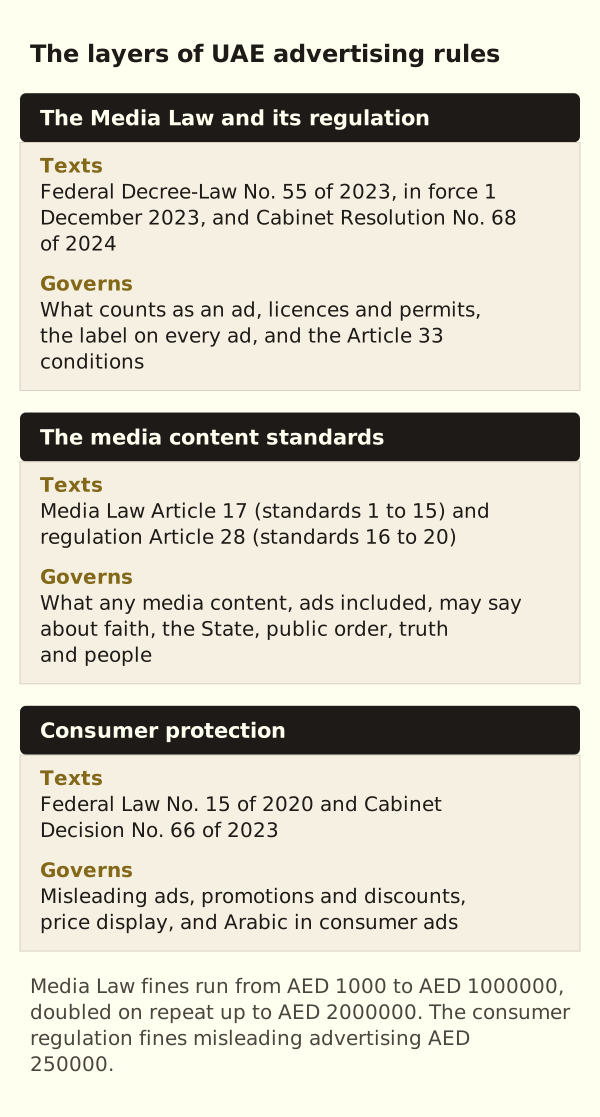
UAE advertising law rests on Federal Decree-Law No. 55 of 2023 on Media Regulation, the Media Law, in force since 1 December 2023. It treats content shown to the public to market a product or service as an advertisement, paid or unpaid, and it reaches media free zones too. Every ad must be marked as advertising, and must meet the conditions in Article 33 of Cabinet Resolution No. 68 of 2024 and the 20 media content standards that the National Media Authority (formerly the UAE Media Council) publishes. Federal Law No. 15 of 2020 on Consumer Protection adds rules on misleading claims, promotions, prices and Arabic.
Every ad we write is checked against Article 33 and the standards before it runs, and specialised ads wait for their approval. This page sets out what the texts say, with sources. It is not legal advice, and how a rule applies to your ad is a question for your counsel.
The Media Law and what it treats as advertising
The Media Law, Federal Decree-Law No. 55 of 2023, was issued on 2 October 2023 and took effect on 1 December 2023 (Article 31), repealing the 1980 Publications and Publishing Law. Article 1 defines an advertisement as content shown to the public by any means, electronic or on paper, "for the purpose of marketing a product or service, for or without compensation." Payment does not decide whether something is an ad, and Article 8 counts electronic and digital media activities as media activities, paid or unpaid.
The law applies to every person, establishment, institution and outlet practising media activities in the State, media free zones included (Article 2). A free-zone licensee whose media activity goes beyond the zone falls under the laws in force in the country (Article 6). The National Media Authority (formerly the UAE Media Council) took over the Council's functions under Federal Decree-Law No. 11 of 2025, and it regulates media activities in media free zones "in the same manner as those operating elsewhere in the State." The texts predate the Authority, hence they say "the Council".
Article 20 holds the core duties. No ad may breach the media content standards or harm the public interest, directly or indirectly, and "All advertisers must include in all advertising materials something that explicitly and clearly indicates that it is advertising material."
A media licence or permit does not replace other authorities' approvals (Article 7). Individuals who advertise on social media need a permit from the regulator (Article 12), covered in our guide to the UAE Advertiser Permit.
Article 33, condition by condition
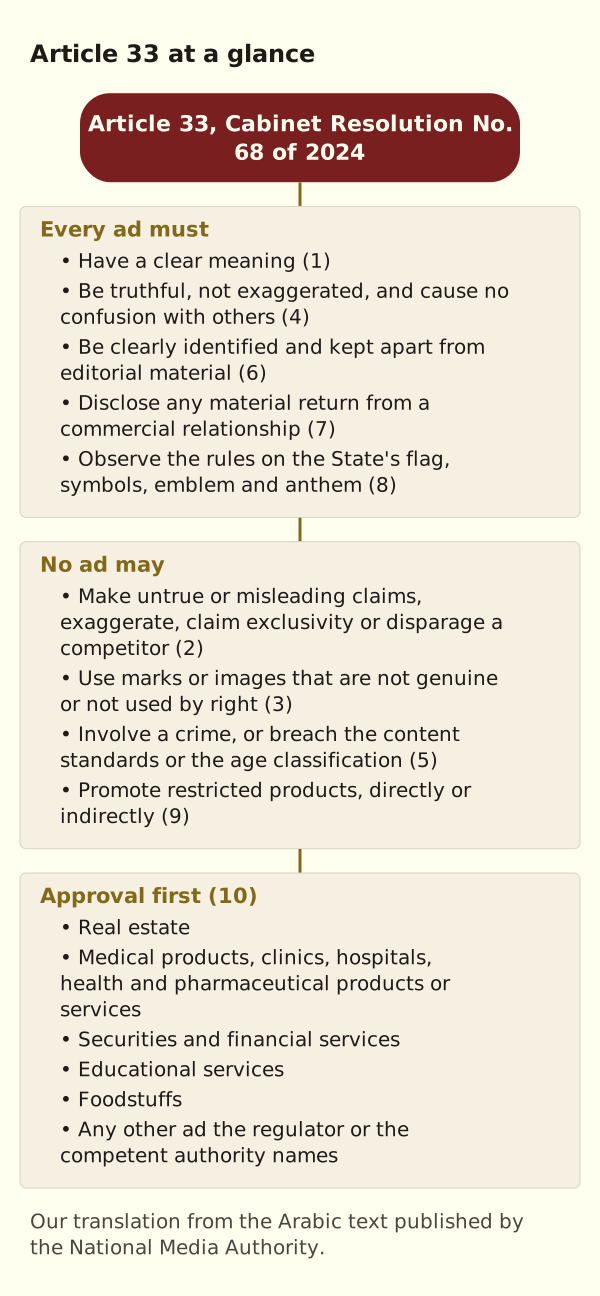
Cabinet Resolution No. 68 of 2024, the Media Law's Executive Regulation, takes effect 3 months after its publication in the Official Gazette (Article 35). Its Article 33 bars any ad that breaches the content standards or harms the public interest, and it names media free zones among those it binds. In our translation of the Arabic text the NMA publishes:
- (1) The ad must have a clear meaning, with nothing vague or ambiguous.
- (2) No untrue or misleading claims, and no exaggeration, claims of exclusivity, disparagement of a competitor or anything that suggests fraud or deception.
- (3) Marks and signs must be genuine and used by right, and so must images.
- (4) The ad must be truthful and not exaggerated, and must cause no confusion with another name, or with other products or activities.
- (5) It must not involve a crime or breach the content standards and the age classification in force.
- (6) Ads must be clearly identified and kept distinct from editorial and media material, with boundaries between the ad and other material, and time breaks in broadcasting.
- (7) Where an ad carries a person's or an entity's promotion or endorsement of a product or service, the advertiser must clearly disclose any material return within a commercial relationship with whoever owns it.
- (8) The conditions on using the State's flag, symbols, emblem and national anthem apply.
- (9) No direct or indirect promotion of restricted products, in any form. The regulation lists them.
- (10) The concerned authority's approval, and its requirements, for real estate ads, ads for medical products, clinics, hospitals or health and pharmaceutical products and services, ads on securities and financial services, ads for educational services, food ads, and any others the regulator or the competent authority names.
We hold an ad until its item 10 approval arrives, and we plan for it in clinic work, set out in healthcare advertising approval in the UAE, and in restaurant marketing in Dubai. Item 9 shapes the whole of nightlife marketing in Dubai.
Article 27 lists "design and production of advertisements of all kinds" and "media and advertising consultancy and studies" (our translation) among the activities the regulator licenses, and no other authority may license them before the regulator approves.
The 20 media content standards, grouped by subject
The 20 media content standards are the base layer of advertising standards in the UAE, since every ad must meet them. Standards 1 to 15 are Article 17 of the Media Law and 16 to 20 are Article 28 of the Executive Regulation. We number them in the NMA's order and group them by subject, in its words or close to them.
Faith and values:
- (1) Respect the Divine Entity, Islamic beliefs, monotheistic religions and other beliefs, and offend none of them.
- (5) Respect the UAE's cultural and civilisational heritage and its national identity.
- (8) Do not offend the prevailing values in society, and observe the public interest.
- (18) An ad's content must respect the values of the UAE, and its culture and identity. Only this standard names the advertisement.
The State:
- (2) Respect the State's system of governance with its symbols and institutions, and the highest interests of the State and society.
- (3) Respect the State's orientation and policy at home and abroad.
- (4) Avoid anything that might harm the State's foreign relations.
- (9) Do not offend the UAE's legal, economic, judicial and security system.
- (14) Publish nothing that might harm the national currency or the State's economic situation.
Public order:
- (6) Publish nothing that harms national unity and social cohesion.
- (7) Stir up no sectarian or tribal strife, or strife between regions, and incite no violence, hatred, terrorist acts or discord.
- (11) Publish nothing that might incite crime or encourage the use of restricted products.
- (12) No phrases, pictures, drawings or opinions that violate public morals or offend young people, and no call to embrace or promote subversive ideas.
- (16) Do not glorify groups with destructive political, ethnic, economic, ideological or social tendencies that are adverse to the UAE or serve their own interests.
Truth:
- (13) No false news, and no papers that are forged or wrongly attributed to an entity or a person.
- (15) Spread no rumours or misleading news.
People and audiences:
- (10) Respect privacy and the private lives of individuals.
- (17) Select appropriate individuals when hosting people or accepting their contributions.
- (19) Take account of the age rating system for artistic works approved by the National Media Authority.
- (20) Respect children's rights under UAE legislation.
We check each ad against all 20, in every campaign across our digital marketing work.
What a breach of the Media Law costs
Article 23 of the Media Law sets the penalties, starting with a warning. Fines run from AED 1000 to AED 1000000 and double on a repeat, up to AED 2000000. An establishment or media institution in breach can be closed for up to 6 months, renewable, and an unlicensed one can be closed for good. A licence or permit can be cancelled, along with any approval. The violator can also be made to pay to remedy the harm, and penalties under other laws still apply. The UAE Government portal summarises the same consequences.
Article 24 leaves the detailed schedule to the Cabinet, which issued it as Cabinet Resolution No. 42 of 2025. A breach of the advertising conditions in Article 33 is fined AED 20000 the first time and AED 50000 the second, doubled on repeat. Breaches of the content standards are fined by degree, and the top fine in that table is AED 1000000. Which row fits a particular ad is a question for the regulator and your counsel.
Misleading advertising and the consumer law
Misleading advertising in the UAE is a consumer protection breach as well as a media one. Federal Law No. 15 of 2020 on Consumer Protection covers all goods and services in the State, "including free zones" (Article 3), and Cabinet Decision No. 66 of 2023 is its Executive Regulation. The 2023 amendment left the advertising articles as written, and the amended Article 22 lists combating misleading advertisements among the Ministry of Economy and Tourism's duties.
In the law's definition, a misleading advertisement rests on deceptive information or leaves out essential information about the good or service, in a way that affects the consumer. Fake prizes or discounts count. Article 17 bars the advertiser and the supplier, along with the commercial agent, from describing a good or service with incorrect data or advertising it in a misleading way. Article 8 of the regulation lists 7 heads on which a false or misleading impression makes a claim deceptive, among them composition, country of origin, price and warranty terms, quality marks and the results expected from use.
The rules on offers and prices sit beside it:
- Promotions such as prize draws and special offers, and general price discounts, need a prior licence from the competent authority, and so does advertising them (Law Article 18). In Dubai that means promotion permits before launch.
- Prices must be shown clearly and legibly, and price advertising must not mislead (Regulation Article 5, Law Article 8). Charging above the advertised price is prohibited (Law Article 19).
- Consumer advertisements and contracts, and the data given to consumers, must be in Arabic, and other languages may be added (Law Article 26).
The regulation's fines table sets AED 250000 for describing a good or service with false particulars or advertising it in a misleading way, and AED 100000 for consumer advertisements and contracts not in Arabic. Misleading price advertising and unclear prices carry AED 100000 each. A repeat doubles the fine, and the sanctions reach temporary closure for 24 hours to 90 days and revocation of the licence. A breach of Article 17 can also bring imprisonment of up to 2 years and a fine of AED 10000 to AED 2000000, or either.
Marking an ad as an ad
The duty to mark an ad as an ad sits with the advertiser. Article 20(2) of the Media Law asks for something in all advertising material that indicates "explicitly and clearly" that it is advertising. Article 33 adds 2 conditions: ads are kept distinct from editorial material (item 6), and the advertiser discloses any material return behind an endorsement (item 7).
No current primary source fixes the wording. We checked the NMA's permit guide, its FAQ, its service pages and its content standards page, and none prescribes a hashtag or a set phrase, in English or in Arabic. We label paid work in plain words, such as "Advertisement" or "Paid partnership", because a plain word meets the explicit and clear test better than a vague phrase. That is our practice, and no text requires those words.
The same label and disclosure apply in our influencer partnerships, where a creator advertising on social media also needs the regulator's permit. In our public relations work, a paid placement is marked as advertising and kept apart from editorial coverage, since item 6 asks for that separation.
What's included
Four areas of scopeArticle 33 checks before an ad runs
We read every line against the 10 items of Article 33 and the 20 content standards, and a line that fails is rewritten or cut.
A plain label on every paid piece
Paid posts and sponsored articles carry a plain label such as "Advertisement" or "Paid partnership", and any material return is disclosed. The words are our choice, since no current rule fixes them.
Specialised ads wait for approval
Real estate, health, finance, education and food ads need the concerned authority's approval under Article 33(10). You or your PRO file for it, and we build the timeline around it.
Claims with evidence behind them
We write no claim the advertiser cannot support, and nothing Article 33(2) bars: exaggeration, claims of exclusivity, disparagement of a competitor or any hint of fraud.
How the work runs
A review of your live ads
We read your live ads and landing pages against the rules on this page and mark each line that needs to change, with the rule behind it.
Campaigns written to the rules
We write and run the campaign with the checks built in, and with time in the plan for any approval a specialised ad needs.
When to come to us
- 01You are launching in the UAE and want the first campaign written to UAE rules.
- 02You operate from a free zone and want to know which federal rules reach your ads.
- 03Your campaign covers real estate, health, finance, education or food, and needs an approval before it runs.
- 04Your plan includes a discount or a prize draw.
What we do not do
- We do not give legal advice. How a rule applies to your ad is a question for your counsel.
- We do not get specialised ads approved on your behalf. You or your PRO file with the concerned authority, and we build the timeline around that approval.
- We do not write misleading claims, however they are worded.
- We never promise an approval, because the decision belongs to the authority.
Related reading
The order of approvals, and where campaigns most often go wrong.
Partnerships with the trade voices, specialist newsletters and podcasts your buyers already follow.
Marketing a licensed venue in Dubai under rules that bar any promotion of its restricted products.
Trade press coverage in the publications your buyers already read.
Common questions
Do the rules apply in free zones?
Which ads need approval before they run?
Can an ad compare a product with a competitor's?
Who answers for a misleading ad, the brand or its agency?
Sources
- National Media Authority, Frequently asked questions, accessed October 2026
- National Media Authority (WAM), decree-law establishing the Authority, 18 December 2025
- National Media Authority, Media legislation, including Federal Decree-Law No. 55 of 2023 on Media Regulation
- UAE Cabinet, Resolution No. 68 of 2024, Executive Regulation of the Media Law (Arabic text hosted by the NMA)
- UAE Cabinet, Resolution No. 42 of 2025, schedule of media violations and penalties (Arabic text hosted by the NMA)
- National Media Authority, Media content standards, accessed October 2026
- UAE Government portal, Media regulation, updated 12 November 2025
- Ministry of Economy and Tourism, Consumer protection legislations, including Federal Decree-Law No. 5 of 2023, accessed October 2026
- Federal Law No. 15 of 2020 on Consumer Protection, English translation published by the Ministry of Economy and Tourism
- Cabinet Decision No. 66 of 2023, Executive Regulation of the Consumer Protection Law, English translation published by the Ministry of Economy and Tourism
Last reviewed 22 October 2026. How we research, write and correct these pages is set out in our editorial standards.