

Digital MarketingService
UAE data protection rules for marketers
What the UAE's data and SMS rules ask of a marketing team, with the article behind each point.
Kaelo Global is a Dubai company licensed in Meydan Free Zone, with over 100 clients served so far.
At a glance
What it is
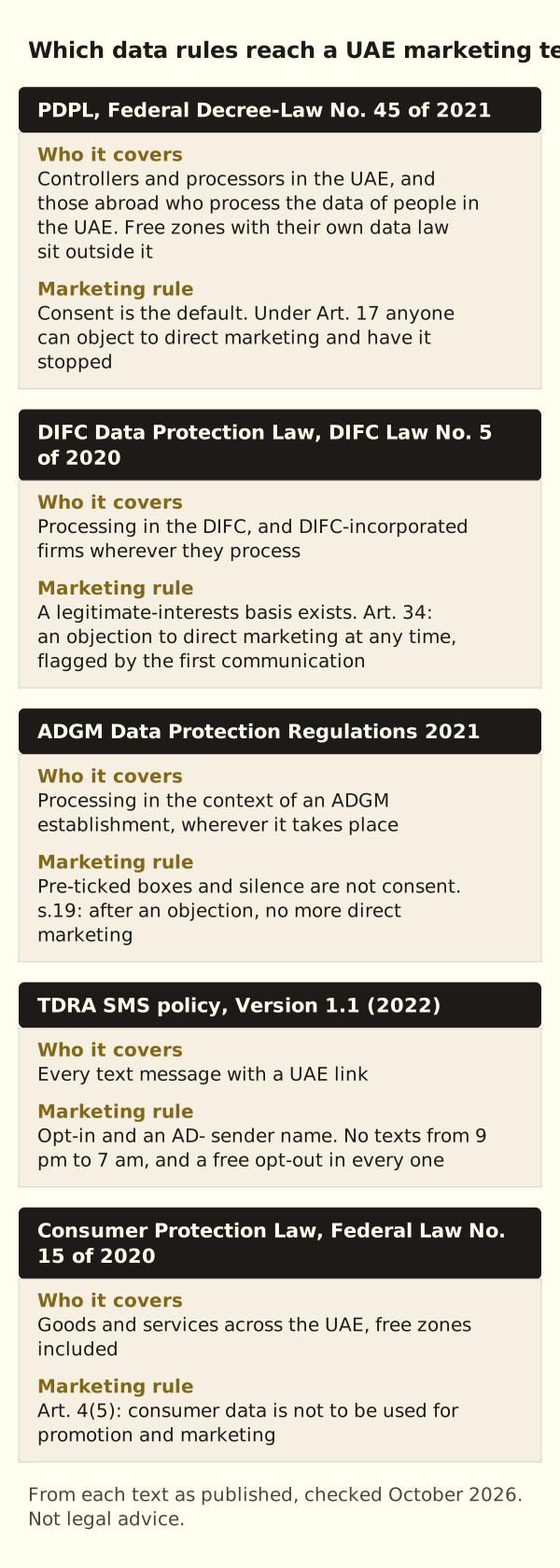
The UAE PDPL, Federal Decree-Law No. 45 of 2021, has governed personal data since 2 January 2022. For marketing, consent is its default. On our reading, its list of exceptions has no general legitimate-interests ground, and Article 17 lets anyone object to direct marketing and have it stopped.
Marketing SMS also falls under TDRA's policy, which allows texts only to people who opted in and bars them between 9 pm and 7 am. Each marketing text must carry an AD- sender name and a free opt-out. Companies in DIFC and ADGM answer to their own data laws. As of 22 October 2026, no official source shows the PDPL's Executive Regulations as issued, so no PDPL fine or breach deadline can be stated yet.
We are marketers, and this page is not legal advice. It cites each text by article and marks the questions for your counsel.
The PDPL: who it covers, and where it stands in October 2026
The PDPL, Federal Decree-Law No. 45 of 2021 Concerning the Protection of Personal Data, was issued on 20 September 2021 and has been in force since 2 January 2022 (Art. 31). Its definition of processing includes sharing and exchanging data, so passing a list to an agency or a sister company is processing too.
It applies to controllers and processors in the UAE, wherever the people in their data are (Art. 2(1)(b)), and to those abroad who process the data of people in the UAE (Art. 2(1)(c)). Article 2(2) leaves out:
- government data, and government entities that control or process personal data
- data held by the security and judicial authorities, and a person processing their own data for personal purposes
- banking and credit data, and health data, where another law regulates their protection
- companies in free zones with their own data protection legislation, which is where DIFC and ADGM sit
The PDPL sets no fines. Article 26 leaves the violations and the administrative penalties to a Cabinet decision. The regulator it names is the UAE Data Office, created by Federal Decree-Law No. 44 of 2021. On 14 June 2026 the Cabinet approved a new Artificial Intelligence and Data Authority, which "will bring together under one mandate the functions previously held by three separate entities", the Data Office among them. No published text yet settles whether it enforces the PDPL against private companies.
The Executive Regulations were due within 6 months of the law's promulgation (Art. 28), and the compliance window runs up to 6 months from their issue (Art. 29). As of 22 October 2026, no official source shows the Executive Regulations or the Article 26 decision as issued. Trowers & Hamlins (June 2026) call the PDPL "in force but unenforceable" pending the Regulations, and GLA & Company (August 2026) write that "the enforcement regime remains uncertain". The breach deadline (Art. 9) and the transfer controls (Art. 23(2)) wait on the Regulations too, so this page states no PDPL fine, breach deadline, compliance date or list of approved countries.
Consent is the default, and consumer data has a rule of its own
Article 4 prohibits processing personal data without the owner's consent, then lists 11 exceptions. They include the public interest, data the person has made public, a contract with the person and obligations under other UAE laws. On our reading, none of them is a general legitimate-interests ground, and the contract exception (Art. 4(9)) covers order processing and service messages without reaching marketing.
Article 1 defines consent as a specific and unambiguous indication, given through "a clear positive statement or action". On our reading, a pre-ticked box or silence does not fit. The controller must be able to prove consent, and consent must carry the right to withdraw it easily (Art. 6(1)). A withdrawal leaves earlier processing lawful (Art. 6(2)). This site records each visitor's consent choices and keeps enquiry data on its own servers. Our privacy policy and cookie policy give the detail.
In the CRM, data serves the specific and clear purpose it was collected for, or a similar or close one (Art. 5(2)), and is not kept once that purpose is exhausted (Art. 5(7)). Before processing starts, people must be told which sectors or establishments in the UAE and abroad will receive their data (Art. 13). Article 22 allows transfers to a country with data protection legislation, in cases the regulator approves. Otherwise Article 23 offers routes such as a contract binding the recipient to the law's standards, or the person's explicit consent. That matters whenever a CRM or an ad platform stores contacts outside the UAE.
A group gets no exception for sharing between its own companies, on our reading of Article 4. Our work for multi-brand groups starts by mapping which company collected each contact and what the person was told.
The Consumer Protection Law, Federal Law No. 15 of 2020, adds a rule of its own for goods and services across the UAE and its free zones (Art. 3). Article 4(5) lists among the consumer's rights "Protecting the privacy and security of his data and not using it for promotional and marketing purposes", and the government portal says the law "prohibits suppliers from using it for marketing". How that sits beside a consent given under the PDPL is a question for your counsel. What an advertisement may say is covered in our page on UAE advertising law.
Article 17 and the other rights, read for a mailing list
Article 17(1) gives a person the right to object to processing "for the purposes of direct marketing, including profiling related to direct marketing", and to have it stopped. The official Arabic text says the same. An objection logged in 1 tool and missed in another has not stopped anything, hence a single suppression list read by every tool.
Retargeting and lookalike audiences raise the profiling question. The PDPL defines profiling as automated processing that uses personal data to assess certain personality aspects of the person (Art. 1). Whether a given audience is profiling is a question for counsel, and the answer shapes how we set up analytics and measurement and paid media.
The other rights, and what each means for a list:
- Information (Art. 13(1)). A person can ask, free of charge, what types of data you hold and who receives it.
- Portability (Art. 14(1)). The data they gave you has to come out in an orderly, machine-readable form.
- Correction (Art. 15(1)). A fix made in the CRM belongs in every copy of the list.
- Erasure (Art. 15(2)). It can follow a withdrawal or an objection. Whether a suppression entry may stay after erasure is a question for counsel.
- Restriction and human review (Art. 16, Art. 18). A person can oblige you to restrict processing in the cases Article 16 lists, and can ask for a human to review an automated decision.
People can also complain to the regulator (Art. 24(1)).
SMS and email: what TDRA's texts say, and what they leave out
TDRA regulates spam through regulatory policies, which bind telecom licensees and, through their contracts, the businesses that send bulk messages. For text messages the current text is Version 1.1 of the policy, issued on 13 June 2022, and it applies to every text with a UAE link (s.3.1). Its rules for marketing texts:
- Opt-in only. Without consent a person is deemed not to have agreed (s.1.17), and the operator verifies consent before a marketing text goes out (s.8.2.3).
- A business sending through an operator may not ask for consent by text or by voice call (s.9.2.5), so SMS consent is gathered on a form or in an app.
- The sender name carries the code AD- followed by the sender's name (s.8.8).
- No marketing texts between 9 pm and 7 am (s.8.3, s.9.2.4).
- Every marketing text carries an opt-out, and unsubscribing costs nothing (s.5.8, s.5.10).
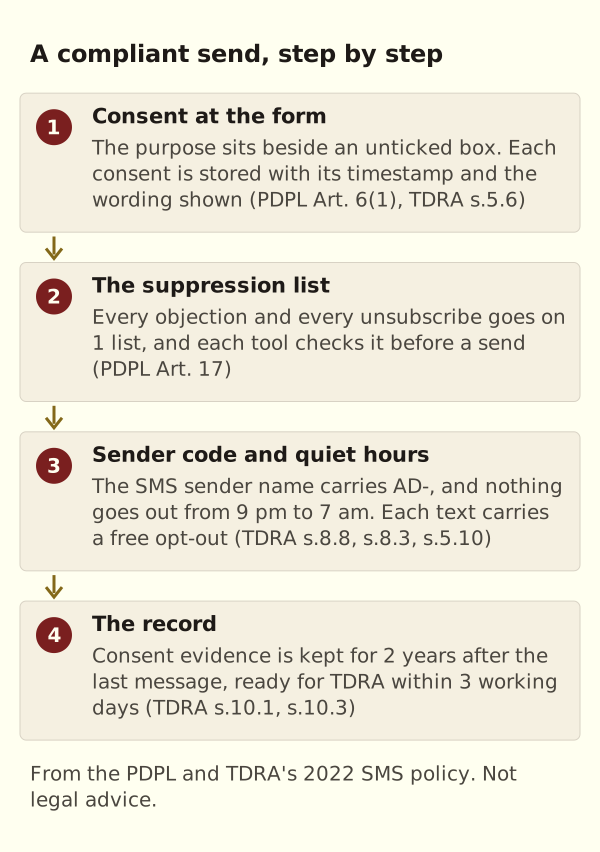
- Consent records hold the date and time along with the wording and the person's identity. Operators keep them for 2 years after the last message and produce them within 3 working days of a TDRA request (s.5.6, s.10.1, s.10.3).
A business that breaks these terms has its messaging service suspended and is reported to TDRA (s.12.3). TDRA's FAQs tell consumers that only senders whose names start with AD can be blocked. Telemarketing has regulations of its own, covered in our page on UAE telemarketing rules.
For email marketing, TDRA's texts say less. The 2009 policy, Version 1.0, covers electronic communications with a UAE link, and its definition of an address includes email (s.1.5, s.3.1). It asks for opt-in consent before marketing (s.5.5, s.6.8) and an unsubscribe route in every marketing message (s.6.10). Those duties fall on telecom licensees, and the 2022 version rewrote only the text-message rules. We found no TDRA statement on whether the 2009 policy still applies to email. The PDPL's consent and objection rules apply to the data behind every email, which is how email runs across our digital marketing work.
DIFC: consent and direct marketing
The DIFC Data Protection Law, DIFC Law No. 5 of 2020, has been in force since 1 July 2020 (Art. 4). The text used is the July 2025 consolidation. It applies to processing in the DIFC and to DIFC-incorporated controllers and processors wherever they process (Art. 6). The Commissioner of Data Protection administers it (Art. 8).
Unlike the PDPL, it has a legitimate-interests basis, which gives way where the person's interests or rights override it (Art. 10(f)). A company in a group may have a legitimate interest in moving data within the group for internal administrative purposes (Art. 13(2)). The article does not mention marketing.
Consent must be freely given by a clear affirmative act, and obtained for each purpose in a clearly distinguishable way (Art. 12(1), Art. 12(3)). Withdrawing it must be at least as easy as giving it (Art. 12(5)), and the right to withdraw is absolute (Art. 32(2)).
A person must be told before their data first goes to third parties for direct marketing, and be expressly offered the right to object (Art. 34(1)(b)). They may object to direct marketing at any time, profiling included (Art. 34(1)(c)), and these rights must be put to them prominently and separately by the first communication (Art. 34(4)). Schedule 2 sets the maximum fine per contravention at USD 100000 for Article 34 and USD 50000 for Article 12. Article 62(3) also allows a general fine not limited to the schedule.
ADGM: consent and direct marketing
The ADGM Data Protection Regulations 2021 apply to processing in the context of an ADGM establishment, whether or not the processing takes place in ADGM (s.3(1)). The text used is the February 2024 consolidation, and the amendments published up to September 2025 leave these sections unchanged.
ADGM also has a legitimate-interests basis beside consent (s.5(1)(f)). Consent must be freely given and specific (s.6(1)). It must also be informed and unambiguous, and under section 6(2) silence and pre-ticked boxes do not constitute consent. The controller must be able to demonstrate consent (s.6(4)), and withdrawing it at any time must be as easy as giving it (s.6(7), s.6(8)).
A person may object at any time to processing for direct marketing, including profiling (s.19(3)). The data must then not be processed for that purpose (s.19(4)). No later than the first communication, the right must be presented to them clearly and separately from any other information (s.19(6)).
What's included
Five areas of scopeConsent recorded at the form
Each form states the purpose beside an unticked consent box. We store every consent with a timestamp and the wording shown, because the PDPL asks the controller to be able to prove consent.
A suppression list every tool reads
Every objection and every unsubscribe goes on 1 suppression list, and each tool we send or advertise from checks it before use.
SMS built to TDRA's schedule
Sender names carry the AD- code, and the schedule sends nothing between 9 pm and 7 am. Each text carries a free opt-out, since TDRA's policy requires one in every marketing text.
Group lists mapped before a campaign
For a group, we record which company collected each contact and what the person was told. A shared list waits for your counsel's approval, since the PDPL counts sharing as processing.
Open points written down for counsel
Where the texts leave a point open, such as whether a retargeting audience counts as profiling, we write the question down for your counsel before the campaign is built.
How the work runs
A consent and suppression review
We trace contacts from your forms into every tool that sends to them, and mark where consent is recorded and where an objection could be missed. Points of law go to your counsel.
A campaign set up to the rules
We build the consent capture and the suppression feed, then set the SMS sender code and quiet hours before the first send. You approve every message, and your counsel settles the data questions.
When to come to us
- 01Your CRM holds contacts, and nobody can say when or how each one agreed to hear from you.
- 02An unsubscribe in your email platform never reaches your SMS or ad tools.
- 03You plan marketing SMS in the UAE and want the sender code and quiet hours set before launch.
- 04Your group has companies in DIFC or ADGM and on the mainland, and wants to market across them.
What we do not do
- We do not give legal advice. Questions of law go to your counsel.
- We do not buy or rent contact lists.
- We do not send to anyone who has not opted in, and we honour every objection.
- We do not move data across borders on a client's behalf.
Related reading
For groups deciding which marketing the centre runs and which each brand keeps.
Marketing measurement your finance team can check and trust.
Paid advertising for considered, high-value purchases, measured by the business it brings in.
Helping B2B suppliers get onto the register and in front of UAE government buyers.
Common questions
Does the UAE PDPL apply to B2B marketing contacts?
Is there a legitimate-interests basis for direct marketing in the UAE?
What are the fines under the PDPL?
How fast must a data breach be reported under the PDPL?
What are the SMS marketing rules in the UAE?
Sources
- UAE Legislation portal, Federal Decree-Law No. 45 of 2021 Concerning the Protection of Personal Data, 2021
- UAE Government portal and Dubai Judicial Institute, Federal Decree-Law No. 45 of 2021, official Arabic text, 2023 edition
- UAE Government portal, Data protection laws, updated 4 December 2025
- TDRA Digital Government, news release (WAM) on the establishment of the Artificial Intelligence and Data Authority, 14 June 2026
- Trowers & Hamlins insight on personal data and artificial intelligence in Oman, 22 June 2026
- GLA & Company, The UAE Artificial Intelligence and Data Authority, 27 August 2026
- Ministry of Economy and Tourism, Federal Law No. 15 of 2020 on Consumer Protection, as amended in 2023 (Lexis Middle East translation)
- UAE Government portal, Consumer protection, updated 2 September 2026
- TDRA, Regulatory Policy on Unsolicited Electronic Communications, Version 1.1, 13 June 2022
- TRA (now TDRA), Regulatory Policy on Unsolicited Electronic Communications, Version 1.0, 30 December 2009
- TDRA, FAQs on marketing SMS and spam, accessed October 2026
- UAE Government portal, Cabinet Resolution No. 56 of 2024 on the Telemarketing Regulations, 2024
- DIFC, Data Protection Law, DIFC Law No. 5 of 2020, consolidated version July 2025
- ADGM, Data Protection Regulations 2021, consolidated version February 2024
- ADGM, Data Protection Regulations (Amendment No. 1) 2025, published 9 September 2025
- ADGM, Amendment No. 1 of 2024 to the Data Protection Regulations 2021
Last reviewed 22 October 2026. How we research, write and correct these pages is set out in our editorial standards.