

Digital MarketingService
UAE telemarketing rules for sales teams
What Resolutions 56 and 57 of 2024 ask of a sales team, from the registry check to the call record.
Kaelo Global is a Dubai company licensed in Meydan Free Zone, with over 100 clients served so far.
At a glance
What it is
Cabinet Resolution No. 56 of 2024 sets the UAE's telemarketing rules, and Cabinet Resolution No. 57 of 2024 sets the penalties. Resolution 56 has been in force since 27 August 2024. A company needs prior approval from its licensing authority and must call from local numbers registered under its trade licence. Its team may call only from 9 am to 6 pm, and never a number on the Do Not Call Registry (DNCR). Company fines run from AED 10000 to AED 150000.
We build the lead flow behind the call, so a sales team calls only people who asked to be called. Every lead carries the consent it was collected with, and the registry is checked before a number reaches a dialler.
We are marketers and give no legal advice. The Arabic text of each resolution is authoritative.
What Resolution 56 covers, and since when
Both resolutions were issued on 10 June 2024, and each takes effect 60 days after publication in the Official Gazette. The UAE Legislation portal dates Resolution 56 from 27 August 2024, and Aletihad reported it in force that day. As of 17 October 2026 the Ministry of Economy and Tourism listed no later telemarketing instrument.
Article 1 defines telemarketing as calls to consumers by landline or mobile number. It includes marketing texts and marketing messages through social media applications. A consumer is a natural person, and a call the consumer asked for is not an unwanted marketing call. The rules bind every company licensed in the UAE that telemarkets, free zone companies included (Article 3(1)). Natural persons may not make marketing calls for products or services they provide in their own name (Article 3(2)).
On our reading, a call to a company switchboard about a company purchase may fall outside the resolution, since the resolution's consumer is a natural person. A buyer's own mobile still reaches a natural person, hence we treat every mobile number as covered. For B2B teams we prefer demand the buyer starts, from B2B advertising beyond LinkedIn to a shipper's RFQ, which our freight RFQ response work handles.
Before anyone dials: the duties in Article 4
Article 4 sets the company's standing duties:
- Prior approval to practise telemarketing from the competent authority, the licensing authority that issued the trade licence (Article 4(1)).
- Local numbers registered under the company's commercial licence, and no numbers it does not own or register (Articles 4(3) and 4(13)).
- Training for every marketer, including the basic principles of using the DNCR (Article 4(2)).
- A channel for consumers who want marketing information, and marketing calls to those consumers only (Article 4(4)).
- A register of every marketing call in the authority's form, and a recording of each call (Articles 4(6) and 4(7)). Periodic reports go in within 1 month of their due date (Article 4(8)).
- The source of consumer numbers and data, disclosed when the authority asks (Article 4(12)).
Article 4(4) is the duty marketing can carry. A form or a landing page can serve as that channel, and the consent travels with each lead. We build that flow through paid campaigns that bring in requests, because each number's source is then on file. We do not buy lists, since Article 6(4) bars disclosing consumer data without consent or trading it for reprocessing.
The call itself, in the order it runs
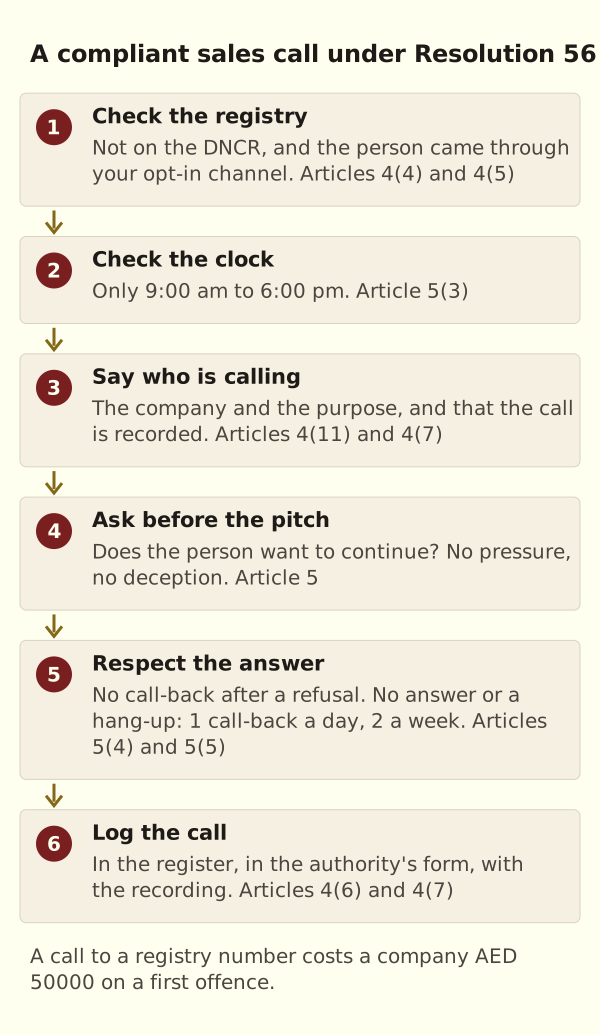
The number is checked against the DNCR before dialling, since Article 4(5) bars marketing calls to registered numbers. Calls go out only from 9:00 am to 6:00 pm (Article 5(3)). The caller opens with the company and the purpose of the call (Article 4(11)) and says the call is recorded (Article 4(7)). The question whether the person wants to continue comes before any pitch (Article 5(7)).
The pitch may not put unjustified pressure on the consumer or mislead them (Articles 5(1) and 5(2)). A refusal on the first call means no call-back (Article 5(4)). After no answer or a hang-up, the limit is 1 call-back a day and 2 a week (Article 5(5)). Automated systems may be used within the same rules (Article 5(6)), and competent authorities may add controls without softening these (Article 5(9)).
Our marketing measurement setup ties the call register to the lead record, so each call traces back to its consent. The ads that bring leads in answer to UAE advertising law.
The Do Not Call Registry, and where marketing texts fit
The DNCR is the national registry, supervised by the Telecommunications and Digital Government Regulatory Authority (TDRA), that protects consumers from unwanted marketing calls (Article 1). The English translation also calls it the Do Not Connect Register. Registration suspends marketing calls and lets the consumer complain about them (Article 6(5)).
TDRA's instruction of 5 August 2026 reads: "Register your number in the Do Not Call Registry by sending DNCR via SMS to 2211 to opt out of authorised telemarketing campaigns." In 2024 its deputy director general described opt-outs "from specific sectors or all sectors".
Texts sit under 2 sets of rules. Resolution 56 counts marketing texts as telemarketing, and TDRA's 2022 SMS policy sets its own mechanics, including an AD- code in the sender name and a free opt-out in every message. Our reading is that a marketing text has to meet both, hence we treat a number on the DNCR as closed to texts too.
The windows differ by channel. Calls run from 9:00 am to 6:00 pm. TDRA's FAQs give 7 am to 9 pm UAE time for marketing texts. A dialler and an SMS platform therefore need separate schedules. Businesses sending through an operator may not ask for SMS consent by text or voice call, hence we collect it on forms. Our guide to UAE data protection for marketers covers the consent rules behind the data.
From a complaint to a penalty
A consumer may complain to the competent authority about unwanted marketing calls (Article 6(1)), and the authority may investigate on its own initiative (Article 6(3)). Under Article 8(1), the authorities and TDRA share data with personal data protection in mind. Article 10 lets the Minister issue rules against practices that circumvent the resolution. Who supervises what (Article 9 and the Ministry's 2024 briefing):
- The Ministry of Economy supervises overall.
- The Central Bank covers banks and other financial institutions, insurers included.
- The SCA covers securities and commodities trading, and asks for its own approval first.
- Local licensing authorities, mainland or free zone, cover the rest in each emirate.
- TDRA manages the DNCR.
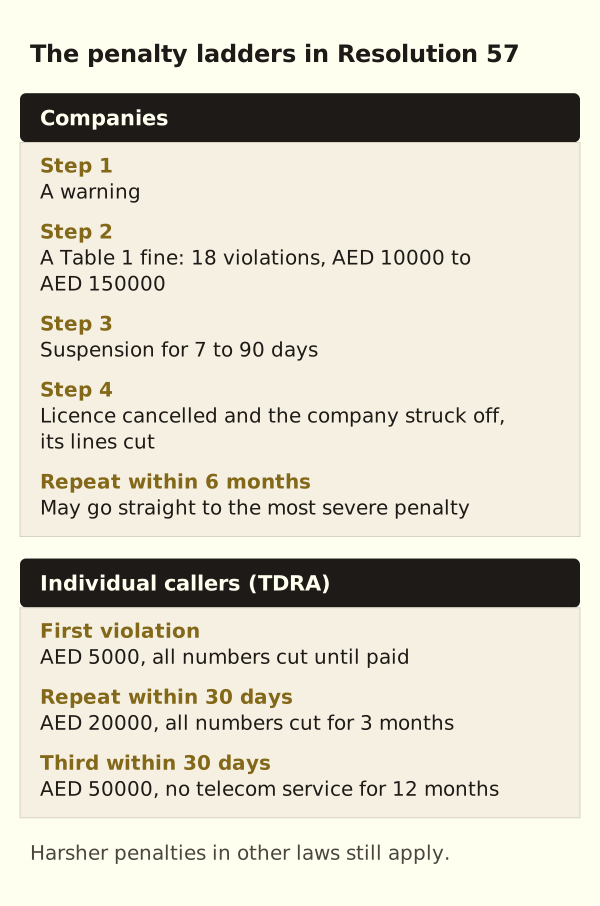
Resolution 57 applies without prejudice to severer penalties in other UAE legislation (Article 2). For a company, a warning comes first, then a fine under Table 1, then total or partial suspension of the activity for 7 to 90 days. The top step cancels the licence and the commercial registration. Communications services are cut and the phone number removed. A repeat of the same violation within 6 months lets the authority go straight to the most severe penalty.
Table 1 lists 18 violations, each with a fine that rises on a second and a third offence. Of those, 3 rows top out at AED 150000, 3 at AED 75000, 8 at AED 50000 and 4 at AED 30000. First offence to third:
- No prior approval, Article 4(1): AED 75000 to AED 150000.
- Calling a number on the DNCR, Article 4(5): AED 50000 to AED 150000.
- Disclosing or trading consumer data, Article 6(4): AED 50000 to AED 150000.
- Calling outside the window, Article 5(3): AED 10000 to AED 50000.
Individual callers answer to TDRA, which acts with the licensed operators. A first violation costs AED 5000, with every number in the person's name cut until the fine is paid. A repeat within 30 days costs AED 20000 and a 3-month cut-off, and a third within 30 days AED 50000 and 12 months without telecom service. TDRA's post of 5 August 2026 listed, as of June 2026, 3301 violations issued against individuals, 92748 numbers reported and 9433 numbers disconnected, followed by "AED 19.19 million in total".
Banks and insurers under the Central Bank's regulation
The Central Bank's Telemarketing Regulation, Circular C 3/2026, has been in force since 31 March 2026. It was issued to fulfil the requirements of Resolution 56. It binds all licensed financial institutions on a group-wide basis, and each must make its third-party service providers comply. It adds:
- Written board approval before any telemarketing, and at least 15 hours of training per telemarketer.
- Prior express consent, covering how the customer may be contacted, robocalls included, with age verification at that point. Consent given on a call must be explicit and verbal, with the audio kept.
- Withdrawal at any time without cost, after which contact stops and the customer comes off the list.
- No telemarketing to anyone who opted out or is on the DNCR, and every call states the right to register in it.
- Calls from 9:00 am to 6:00 pm, no more than 1 call a day and 2 a week, with follow-ups only on request. A robocall drops an unanswered call within 15 seconds or 4 rings and connects an answered one to a telemarketer within 2 seconds.
- Records kept for at least 5 years in the Central Bank's format, and an annual report to it. Customers are told calls are recorded.
Sanctions are at the Central Bank's discretion, and institutions had 90 days from 31 March 2026 to comply.
What's included
Four areas of scopeInbound demand to call
Campaigns and landing pages that bring in people who ask to be contacted, the kind of opt-in channel Article 4(4) describes.
Consent on every lead
Each lead record holds the consent as given and the page that collected it, so a number's source is on file.
A registry check before the dialler
No number reaches the dialler before a DNCR check, because a call to a registered number costs a company AED 50000 on a first offence.
Scripts and schedules
The call window and the script follow the resolution. Calls and texts get separate schedules, since their windows differ.
How the work runs
A lead-flow review
We trace where your dialler's numbers came from and whether each has a consent record, and your counsel decides what any gap means.
An inbound build
Campaigns and forms that collect consent, with the registry check before numbers reach the dialler.
When to come to us
- 01Your sales team calls prospects on UAE mobile numbers.
- 02Nobody can say where some numbers on the dialler came from.
- 03You want to stop buying lists.
- 04Your team calls and texts prospects on a single schedule.
- 05Your scripts predate August 2024.
What we do not do
- We do not give legal advice.
- We do not run cold-calling campaigns ourselves. Our lead flow brings your sales team people who asked to be called.
- We do not buy lists.
- We never promise a result.
Related reading
Paid advertising for considered, high-value purchases, measured by the business it brings in.
Marketing measurement your finance team can check and trust.
Where to reach business buyers when LinkedIn costs more than your deals can support.
Helping B2B suppliers get onto the register and in front of UAE government buyers.
Common questions
What are the telemarketing calling hours in the UAE?
How does someone join the Do Not Call Registry in the UAE?
Does Resolution 56 cover B2B sales calls?
Can sales staff call prospects from personal mobiles?
Sources
- Ministry of Economy & Tourism, Cabinet Resolution No. 56 of 2024 on the Telemarketing Regulations, 2024
- UAE Government portal, Cabinet Resolution No. 57 of 2024 (English), 2024
- UAE Legislation portal, Cabinet Resolution No. 56 of 2024, 2024
- Aletihad, UAE's new telemarketing regulations come into force, 2024
- Ministry of Economy, briefing on the telemarketing resolutions, 2024
- Ministry of Economy & Tourism, consumer protection legislation, 2026
- TDRA on X, Do Not Call Registry registration, 2026
- TDRA on X, enforcement figures, 2026
- Central Bank of the UAE, Telemarketing Regulation, Circular C 3/2026, 2026
- TDRA, Regulatory Policy on Unsolicited Electronic Communications v1.1, 2022
- TDRA, FAQs on marketing SMS, 2026
Last reviewed 22 October 2026. How we research, write and correct these pages is set out in our editorial standards.