

Digital MarketingService
SEO for freight forwarders
Organic search built on the lanes your desk wants to win, and judged by the shipments it brings in.
Kaelo Global is a Dubai company licensed in Meydan Free Zone, with over 100 clients served so far.
At a glance
What it is
If your desk would not want the booking, the lane does not need a page.
A principal, Kaelo Global digital marketing
SEO for freight forwarders is mostly a decision about which pages to publish. Service pages and port pages are safe wherever you run the service or have your own staff on the ground. Lane pages are where forwarders get into trouble. Build one only when you hold a rate or space advantage on the lane and your desk can supply detail no competitor could copy. Every other lane goes on your coverage page or a regional trade page, because Google's spam policies list region and city pages that funnel users to a single page as doorway abuse.
On timing, Google is plain. Its SEO Starter Guide says some changes "might take effect in a few hours, others could take several months", and it suggests waiting a few weeks before judging the work. No one can promise a date for the first page of results, hence we report the enquiries and shipments that organic search brings in, lane by lane, and use rankings only to diagnose a drop.
The pages a forwarder's site should carry
Buyers do much of their checking before they speak to anyone. In Gartner's survey of 646 B2B buyers, run in August and September 2025, 67% said they prefer buying without a sales rep, and 45% had used AI during a recent purchase. That survey covers all B2B buying. For freight, Transport Intelligence's 2026 forwarding report found that preferred supplier lists have overtaken tenders as shippers' main sourcing method, at 45.8% against 33.7%. A shipper draws up that list before asking anyone to quote, so the pages it finds have to show which lanes you run.
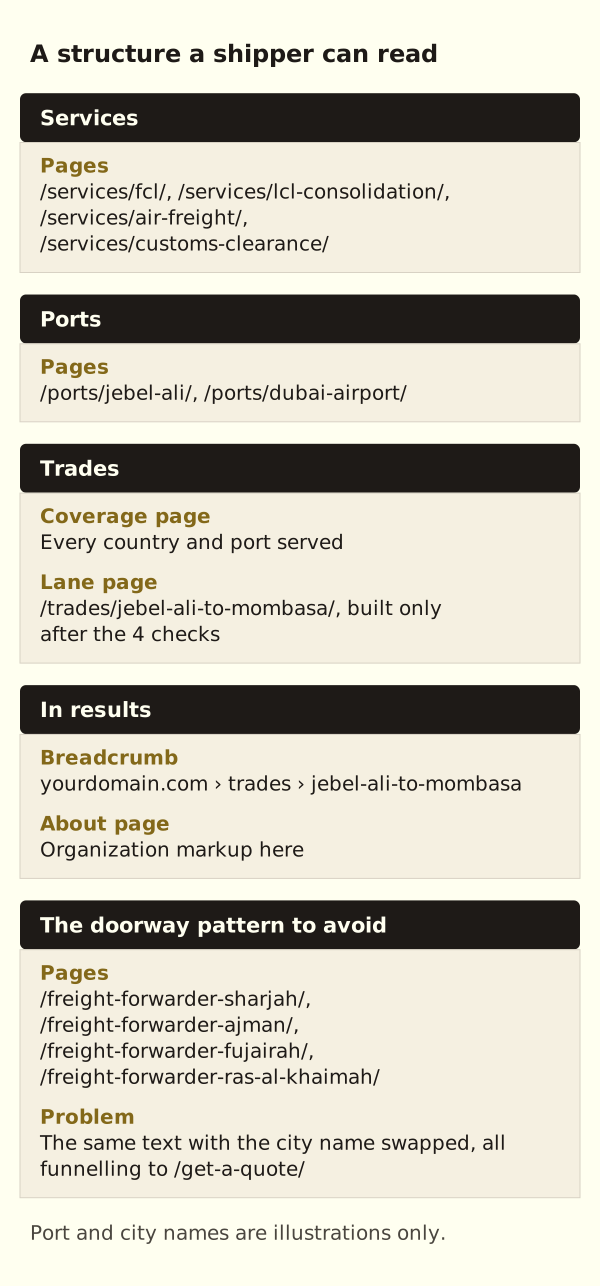
A forwarder's site needs 5 kinds of page:
- Service pages for what you run yourself, such as FCL, LCL consolidation, air freight, sea-air and customs clearance.
- Port pages for the seaports and airports where you have your own staff or a long-standing agent.
- A coverage page listing every country and port you serve, with the modes for each.
- Trade pages for a region you serve well, such as the Gulf to East Africa, covering several lanes at once.
- Lane pages, few in number, for the corridors that pass the checks below.
Google's starter guide links site structure to crawling on sites with thousands of URLs, and says search engines will likely understand your pages as they are. A small site needs no restructuring for Google's sake. Descriptive folders still help the shipper, because "Parts of the URL can be displayed in search results as breadcrumbs". The build itself is covered under what a freight website has to do, and contract warehousing, sold to a different buyer, under marketing for 3PLs.
When a lane earns its own page
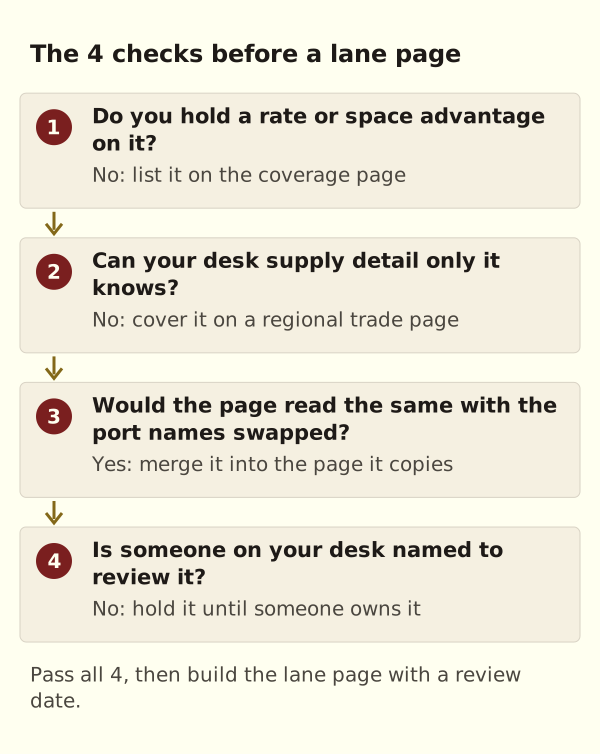
We run 4 checks before writing a trade-lane landing page.
The first is commercial. The lane needs a rate or space advantage behind it, such as a contract rate with the line, a weekly space allocation, a block space agreement with an airline or your own consol box. If your desk would quote the lane through a co-loader at the market rate, the lane stays on the coverage page, because a page cannot win cargo your buying rate will lose.
The second is substance. Google's guidance on helpful content asks whether a page shows "first-hand expertise and a depth of knowledge". For a lane, that means detail only the people who move cargo on it can supply:
- the routing you use, including any transhipment port
- vessel cut-offs and, for LCL, the day the box closes
- the clearance steps at destination that hold cargo up
- the equipment you can get, such as reefers or flat racks
- free time and detention at destination, as you negotiate them
A lane without that detail belongs on a trade page. The third is the swap test. If the page would still read correctly with the port names changed, it is a template, and we merge it into the page it copies. The fourth is ownership. Each lane page needs a named reviewer on your desk and a review date, because Google calls trust the most important part of E-E-A-T, and last season's cut-offs tell a shipper you no longer run the lane.
Expect a short list. The lanes that pass are the ones your desk most wants to fill, hence the ones worth a page. The same list drives our campaigns for freight forwarders and the rest of our logistics marketing practice.
The pages to leave out
Google's spam policies describe 2 patterns a forwarder's site can fall into without anyone intending it.
Doorway abuse is the first. Among Google's examples: "Having multiple domain names or pages targeted at specific regions or cities that funnel users to one page". In freight, that is a page for every emirate or city you collect from, with the same text and the same quote form. If you have no office in Sharjah and no service that differs there, a Sharjah page tells the shipper nothing new.
Scaled content abuse is the second. Google's definition reads "Scaled content abuse is when many pages are generated for the primary purpose of manipulating search rankings and not helping users", and it applies however the pages are made. A "shipping from X to Dubai" page for every country you could book through a partner fits that description, and so do lane pages that differ only in the port names.
Pages for ports you reach only through a co-loader go too, since they draw enquiries your desk can only quote at the market rate. Existing pages that fail are merged into the coverage page or the lane page that now holds their content, and each old URL redirects there with a 301.
How long organic search takes, in Google's words
Google's SEO Starter Guide answers this directly: "Some changes might take effect in a few hours, others could take several months. In general, you likely want to wait a few weeks to assess whether your work had beneficial effects in Google Search results."
When we publish or change a lane page, we ask Google to recrawl it. Google says "Crawling can take anywhere from a few days to a few weeks", and that a request does not guarantee the page will be included at all.
Google's page on hiring an SEO says "No one can guarantee a #1 ranking on Google", and tells site owners to ask what results to expect, and in what timeframe. Our written answer lists the work in order and the measures we report each month. It names no ranking and no date for the first page, because neither is ours to promise.
Indexing and impressions show first. Enquiries and shipments take longer, since a shipper who reads a lane page in March may have no cargo on that lane until the next contract round.
What to track, lane by lane
A ranking report shows where a page sat for a single query on a single day. Your desk needs to know whether the page brought cargo. We report 5 measures for each lane and service page:
- Indexed: the page is in Google's index.
- Seen: impressions and clicks for the queries the page was built for.
- Asked: enquiries that landed on the page, logged in your CRM with lane and mode.
- Quotable: the share your desk would quote on commodity, Incoterm, volume and timing.
- Won: shipments booked from those enquiries, and their margin.
Positions still help when a page loses impressions, because they show where the loss happened. Linking an enquiry to a shipment takes work when quotes sit in email and bookings in another system, and we set that up as part of measurement and attribution.
Keep the lane pages and the desk saying the same thing. In Gartner's survey of 632 B2B buyers, run in August and September 2024, 69% reported inconsistencies between a supplier's website and what its sellers told them. The checked facts on a lane page also go into your freight RFQ responses, so we keep both in a single source. If a page states on-time performance, define the measure first, as set out in our note on perfect order and OTIF.
What's included
Five areas of scopeA page plan from your lane list
We start from what you sell, lane by lane, and agree with your commercial team which lanes and ports earn a page of their own.
Lane pages your desk has checked
We draft each lane page from a call with the person who runs the lane. They check every cut-off and routing detail, and the page shows its review date.
Clearing out doorway pages
We audit existing city and country pages against Google's spam policies. The ones that fail are merged, with a 301 from each old URL.
Structured data without promises
Organization markup goes on the home page or the About page, and each office gets a LocalBusiness entry in the most specific sub-type possible. Google does not guarantee that markup shows in results, and its search gallery lists no Service feature, so we promise no rich result.
Reporting by lane
Each month you see the enquiries every lane and service page brought, and the shipments they became.
How the work runs
Inventory against your lane list
We list every page on your site against your lanes and services, and mark the lanes where you hold a rate or space advantage.
A written page plan
Each proposed lane goes through the 4 checks. You get a plan of pages to build and pages to merge, with redirects.
Drafting with your desk
We draft each page and your operations team reviews it. It goes live with a review date, and we request a recrawl.
A quarterly lane review
Rates and allocations move with contracts and seasons, so each quarter we revisit the lane list with your commercial team.
When to come to us
- 01Your site has a page for every emirate or country, and few enquiries come through them.
- 02You can name the lanes where your buying rate or space allocation beats the market.
- 03Someone on your operations desk can review lane pages each quarter.
- 04You plan new lane pages and want them checked against Google's spam policies first.
What we do not do
- Guaranteeing a ranking, or a date for the first page.
- Generating lane or city pages from a template with the place names swapped.
- Buying links, or placing guest posts written to carry them.
- Publishing a lane page your operations team has not checked.
Related reading
Helping forwarders fill the lanes where they are strongest.
Shippers visit to check that you are real and that you run their lane. We make that easy.
Our specialist practice for freight forwarders, customs brokers, carriers, 3PLs and removals companies in the UAE.
Why forwarders sometimes lose tenders they could have won.
Common questions
How many lane pages should a forwarder have?
Should we have a page for each emirate we collect from?
What makes SEO for a freight forwarder different from other logistics SEO?
How long does SEO take for a forwarder?
Sources
- Google Search Central, SEO Starter Guide: The Basics, 2025
- Google Search Central, Ask Google to recrawl your URLs, 2025
- Google Search Central, Do you need an SEO?, 2026
- Google Search Central, Creating helpful, reliable, people-first content, 2026
- Google Search Central, Spam policies for Google web search, 2026
- Google Search Central, Organization schema markup, 2026
- Google Search Central, Local business (LocalBusiness) structured data, 2026
- Google Search Central, General structured data guidelines, 2026
- Google Search Central, Structured data markup that Google Search supports, 2026
- Gartner, Sales survey finds 67% of B2B buyers prefer a rep-free experience, 2026
- Gartner, Sales survey finds 61% of B2B buyers prefer a rep-free buying experience, 2025
- Transport Intelligence, brief on the Global Freight Forwarding 2026 report, 2026
Last reviewed 17 October 2026. How we research, write and correct these pages is set out in our editorial standards.